


Latest news about Strides
Catch up with the latest news about Strides Software.
Tutorial 6 First Fence in a Course
The first fence in a course is one that should be the least influential fence in the course and the one a course designer must get right. Jump 1 should set horse and rider combinations up for the challenges later in the course. It should be the easiest fence in the course but still in touch with the fences that are to come. Horses tend to be a little sluggish earlier in the course, so number 1 should be a fence a rider can ride forward to, to get the horse going forward and confidently.
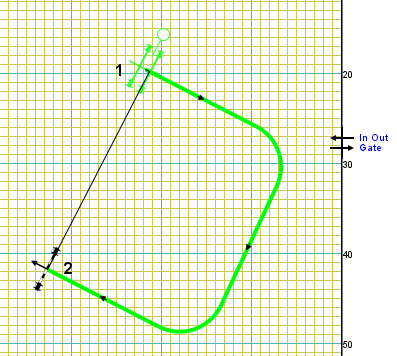
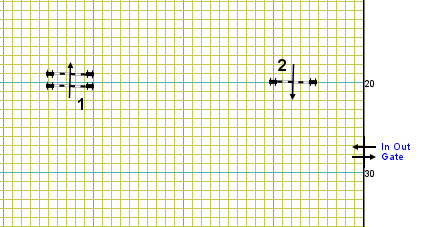
Traditionally it is good practice to set the first fence going heading towards the In/Out Gate. By heading towards the gate, it encourages the horse to naturally go more forward. This is especially significant with green or inexperienced horses. At lower levels I almost religiously have the first fence heading towards to In/Out Gate. See pic 1.
In an ideal world all courses should have the first fence going towards the gate, however when designing multiple courses at a show this is not always possible. Also experienced horses are far more tolerant to jumping the first fence going in different directions. My general rule of thumb is either have the first fence not going away from the gate as shown in pic 2. The other option is to set the first fence a long way from the gate so it will be out of the horse's line of sight. Avoid having the first fence going directly away from the face of the gate, even at the highest levels, see pic 3
The first fence can be a vertical or an oxer. If it is an oxer, I like to build it slightly ascending with the front rail set 5cm lower than the back rail. I also like to build the oxer to the minimum height or 5cm below the rest of the course. The width should be approximately the same as the front rail height. Verticals as fence 1 can be tricky. For experienced horse fillers are ideal to produce a more solid looking fence, but at low levels fillers at the first fence can be too spooky. I like to set at least 4 poles in the first fence but even then, I see getting knocked down more than it should. Recently I have been in a habit of using 4 poles and crossing the bottom two. This allows the front of the cross to protrude out a little and make it a far more inviting start to the course. See pic 4. Again, the first fence should be slightly lower than the rest of the course, but not too low.
By setting an inviting first fence in a course allows both horse and rider to get going into a course and for them to prepare for whatever challenges that are set later in the track.
See the latest Strides Course Design tutorials, visit Strides Tutorial Series on our News page:
Tutorial 1 - 3 stride - 20m rule
Tutorial 2 - Roll back turns
Tutorial 3 - Quick corners
Tutorial 4 - Balanced corners
Line distances - Imperial vs Metric
Tutorial 6 - First Fence in a Course


Check out the ESNZ Podcast about my recent trip to Bogota, my present and past equestrian endeavours. A few days ago, I had the opportunity to chat to Dr Danielle Mulrennan, the Communications and Mar...
Using Draw Reins
Draw reins are a schooling aid that many riders use to keep their horse's head down in a rounded outline. They are especially popular amongst jumping riders, and I see many top riders using them....
Building Confidence in your Horse
When jumping your horse, whether be over cross bars to Grand Prix fences, you need your horse to want to jump for you. Your horse needs to enjoy it. No horse if going to jump if they lack confidence. ...
Strides Exercises update available
There has been a little issue with Strides Exercises, following an update with the strides.co.nz website. This bug has been fixed, but all current users will need to go to the Apple App Store and Goog...
Strides Lite update
Strides Lite has a couple of updates made to it. The jump stands now have feet so they now look the same as the fences on Strides21. I have also introduced the turning dial for turning each fence. Cli...
Learning to see a Stride
One of the fundamental skills in ALL jumping disciplines is the ability to see a Stride. Seeing a Stride is the ability to judge the distance on approach to a jump and adjust your horse's stride ...
A demonstration of Strides Exercises App.
Strides Exercises contains a library of jumping exercises for training Showjumpers, eventers, hunters and all other jumping disciplines. For full access a monthly or annual subscription is required...
Purchasing a Strides Exercises subscription on Android
If you are looking for the best schooling exercises to do at home on your horse, Strides Exercises is a great tool to show you multiple exercises you...
Strides Exercises is now available on the Apple App Store
It is with great excitement that I can announce that the Strides Exercises App for iPhones and iPads is now available on the App Store. This App contains a full list of jumping exercises you can do on...
New pricing plan for Strides Exercises
Strides Exercises now has new prices. It is now $2.99USD ($4.99NZD in NZ) for a monthly subscription and $29.95USD ($49.95 NZD in NZ) for an annua...
